Clean Air Industries

+1 (866) 665 1829

Clean Air Industries

Why Source Capture Is the Smarter Choice Over General Ventilation for Industrial Manufacturing

When it comes to industrial air quality, one size doesn’t fit all – especially if you’re welding, grinding, or plasma cutting on the floor every day. The stakes are high: worker health, equipment performance, and compliance with air quality regulations. That’s why more facilities are shifting from general ventilation to source capture systems – and for good reason.

Let’s break down what makes source capture more effective, how different solutions stack up (like downdraft tables, welding booths, and portable extractors), and why getting your airflow and CFM right matters more than you might think.

Why General Ventilation Falls Short (And Source Capture Wins)

General ventilation tries to clear the air by diluting contaminants throughout the workspace. But here’s the problem: it often doesn’t catch pollutants until it’s too late – after they’ve entered the worker’s breathing zone or spread across your facility.

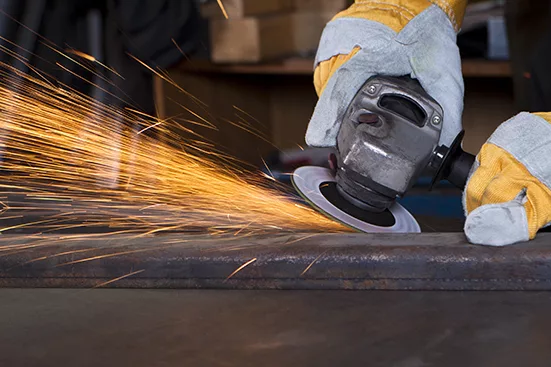
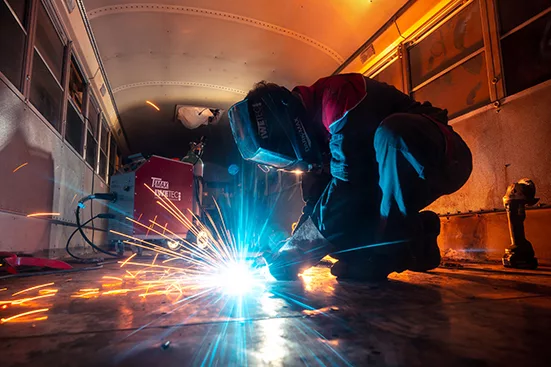
Source capture tackles this at the root. It collects fumes, smoke, and dust right where they’re created – whether at the weld arc, grinding wheel, or plasma cutter. This targeted approach prevents toxic particles from ever becoming a facility-wide issue.

Downdraft Tables, Welding Booths, or Portable Extractors: Which One’s Right for You?

Each of the options below are designed to capture airborne hazards at the point of generation – which is the key to protecting workers and keeping your plant compliant with NFPA and local regulations. Here’s how the most common source capture solutions compare:

Downdraft Tables

Perfect for grinding and plasma cutting. These tables pull contaminants down through the work surface – keeping harmful dust away from your lungs.

Welding Booths

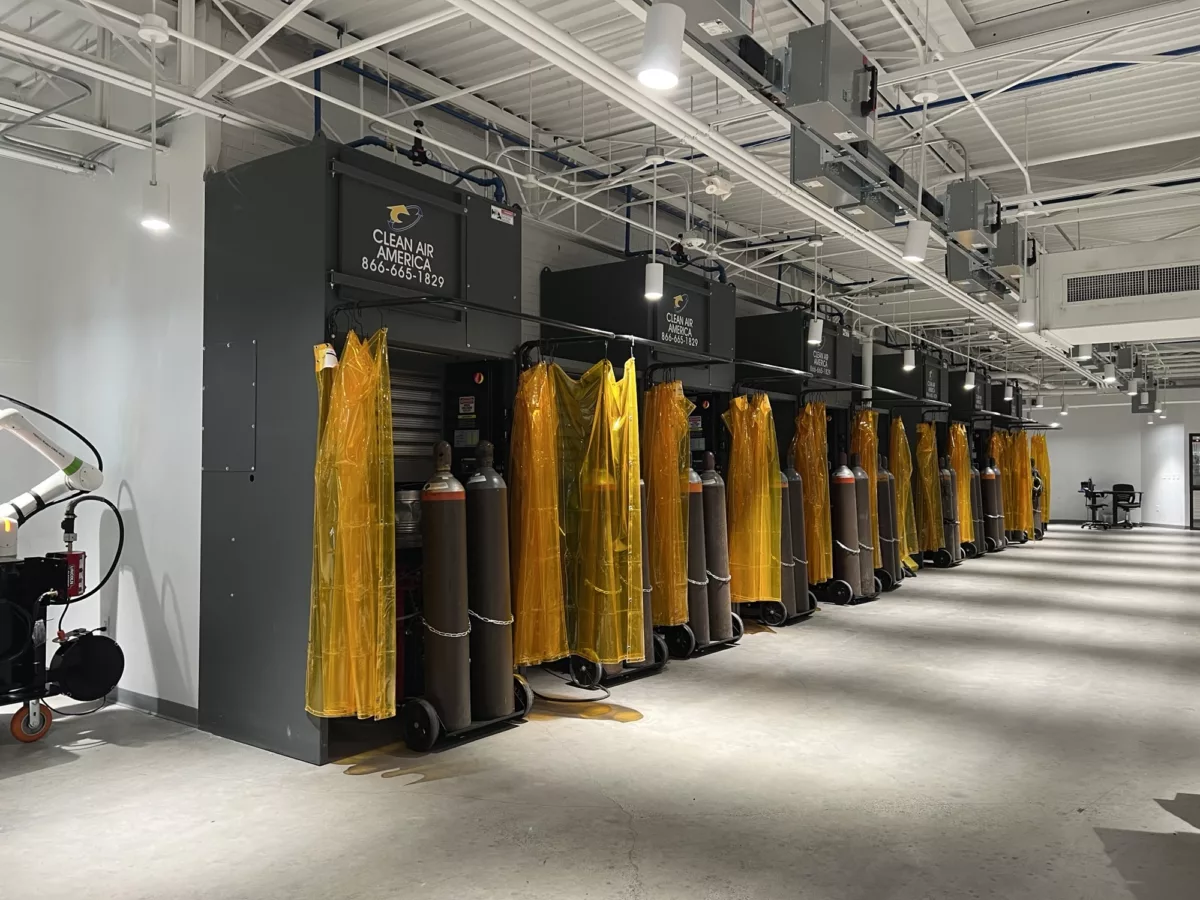
Great for fixed stations. With high-efficiency fume arms and curtains, they create a semi-enclosed space to trap welding fumes where they start.

Portable Extractors

If flexibility is key, these mobile units are ideal. Use them wherever the work is, especially in repair or job-shop settings.

Why Capturing at the Source Is a Game Changer

Toxic fumes like hexavalent chromium, fine metal particulates, and plasma smoke don’t just vanish — they spread, settle, and build up in ways that can impact respiratory health, fire safety, and machine performance.

The smartest way to stop them? Intercept them at the arc, grind, or cut point. It’s not just more effective — it’s also more cost-efficient over time. By reducing the overall air volume needing filtration, source capture systems lower energy use and reduce filter replacement costs.

Getting Airflow Design Right: Don’t Just Guess — Engineer It

Airflow design is where many plants make or break their air quality systems.

  • Not enough airflow? Contaminants escape and circulate.
  • Too much airflow? You’re wasting energy or disrupting work processes.

Smart design includes:

  • Correct capture velocity (often 100–200 FPM for welding tasks)
  • Optimized duct layouts with minimal resistance
  • Strategic hood placement for maximum efficiency

Your air filtration system should work with your process, not against it.

Don’t Overlook CFM — It’s the Backbone of Effective Air Capture

If your system isn’t pulling enough cubic feet per minute (CFM) of air, it’s not doing its job. Period.

Undersized systems allow pollutants to escape as fugitive emissions – which not only endanger workers but can also lead to fines, equipment failure, and a messy workspace. Oversized systems are no better — they waste energy and may create airflow imbalances.

That’s why proper CFM sizing is crucial. It ensures you capture just the right amount of air at the source – nothing more, nothing less.

The Bottom Line: Protect People, Improve Efficiency, Stay Compliant

Source capture is more than just good practice—it’s a smart investment. Whether you’re setting up a new shop or upgrading your ventilation system, choosing the right capture method and airflow design makes all the difference.

With cleaner air, you protect your team, reduce downtime, and meet safety standards with confidence.

Let’s make your facility safer and smarter—starting at the source. Request your Free Air Quality Assessment Today.

Frequently Asked Questions

Source capture systems remove contaminants like fumes, smoke, and dust directly at the point of origin (e.g., welding arc, grinding zone), while general ventilation attempts to dilute airborne pollutants across a larger area. Source capture is more efficient for protecting worker health and maintaining air quality in localized workspaces.
Source capture prevents harmful airborne contaminants from spreading into the operator’s breathing zone or across the facility. For tasks like welding or grinding – where fumes and particulates are concentrated at the source – this method offers superior health protection and energy efficiency compared to general room ventilation.
Improperly sized systems can lead to fugitive emissions or wasted energy. To ensure your system has the correct cubic feet per minute (CFM) airflow, consult with an industrial ventilation expert who can assess your process type, workspace dimensions, and ductwork design.
Portable fume extractors are ideal for mobile or space-limited operations. They offer flexible positioning with articulating arms to provide efficient source capture wherever needed. This is especially useful for job shops, repair facilities, or changing production lines.
Yes. Downdraft tables can be tailored for grinding, cutting, or sanding, while welding booths can be configured for MIG, TIG, or stick welding processes. Proper customization ensures optimal airflow, contaminant capture, and operator ergonomics.

The Ultimate Guide to Cleaner Air: Choosing the Right Defender Downdraft Table for Your Workstation

Cleaner Air Without Lost Time

If you run a shop or production floor, you already know how important it is to keep the air clear of welding smoke, grinding dust, or finishing particulates. The challenge? Doing it without shutting down your operation.

Traditional dust collection retrofits can drag on for weeks. The Defender Downdraft Table changes the story. These workstations are designed to improve air quality immediately — so you protect your team and keep jobs moving.

  • Capture up to 90% of airborne particulates at the source
  • Stay on track with OSHA compliance
  • Improve part quality and reduce costly rework

Choosing the Right Defender Downdraft Table

Every shop is different, and so are the tables. Here’s a quick guide to help you decide:

  • Defender Portable 2×3: Compact, plug-and-play table. Runs on a standard 120V outlet, making it perfect for maintenance or small tasks where mobility matters.
  • Defender 4×3: Small footprint table for single-operator jobs or cellular manufacturing.
  • Defender 4×6: The “everyday” table. Handles welding, grinding and most mid-sized fabrication work.
  • Defender 4×9: Built for big jobs. Extra surface area supports large parts and multi operator tasks.

Comparison chart of Defender Downdraft Tables

Not just for metalworking: Defender Downdraft Tables are also effective for composites, powder mixing, and other fine particulate applications. Our team can help match the right setup to your process.

Defender Ducted Downdraft Tables

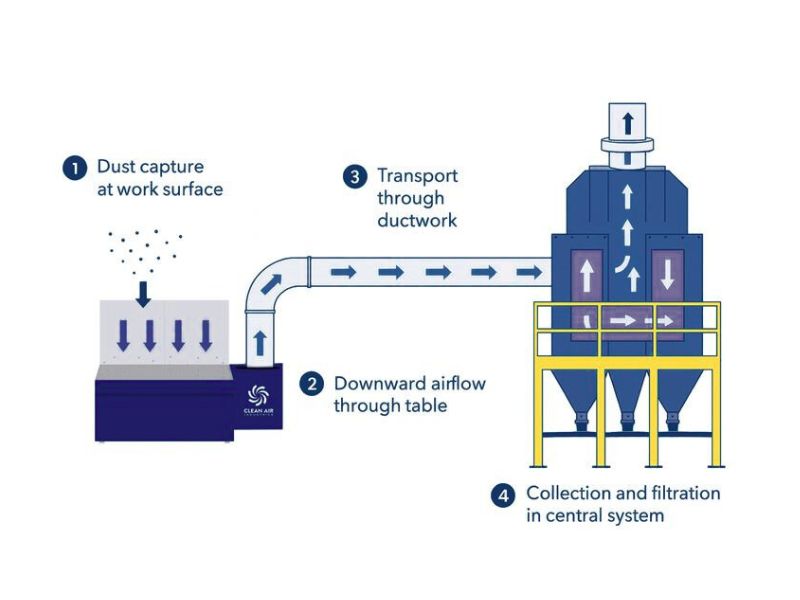
If your facility uses a central dust collector or needs to address combustible dust, a Defender Ducted Downdraft Table may be the right choice. These units are motorless — so they’re less expensive to operate — and integrate directly into your central collection system.

Diagram of Defender Ducted Downdraft Tables integrated into an industrial dust collection system

Built Around Your Work

Every workstation is different, and the Defender series makes it easy to adapt.

Standard Features

  • Quick-release filter access and dust drawers (industrial models)
  • Fire suppression extinguisher ports for added safety (industrial models)
  • Automatic filter cleaning for consistent air flow
  • Rugged grating table surfaces

Optional Features

  • Back walls, sidewalls, or LED lighting (standard on portable models)
  • Metal or Lexan dividers for training or multi-tasking.
  • HEPA afterfilters for high-purity applications.

Standard and Optional Features of Defender Downdraf Tables

Frequently Asked Questions

The Defender Portable 2×3 Downdraft Table can be set up within just minutes—simply plug into a standard 120V outlet and it’s ready to go. By contrast, industrial models (4×3, 4×6, 4×9) are substantially heavier (ranging from 1,175 to 2100 lbs) and require longer assembly time and careful rigging procedures.

The portable 2×3 model is plug and play, running on standard 120V, single phase power.

The industrial 4×3, 4×6 and 4×9 models require a 3-phase power supply (208, 230, or 460V options), which is common in most industrial and manufacturing facilities.

We can discuss other power requirements during your assessment. 

Defender Downdraft Tables are designed for operator comfort. The Defender Portable 2×3 model operates at 74 decibels (dB).

Defender  Industrial models (4×3, 4×6, 4×9) operate at less than 81 decibels (dB) at the operator’s position, which is equivalent to the noise level of a normal conversation.

Yes. We have extensive experience and provide comprehensive installation and support availability to cover the entire U.S., either directly or through our extensive distribution network. Our Sales team can provide a detailed deployment plan specific to your location.

Absolutely. Defender downdraft tables can be used for various applications, including composites and powder mixing. Consult with our team of air filtration experts for specific needs.

Support Made Simple

Routine upkeep doesn’t have to slow you down. Watch how easy maintenance and filter changes can be:

Ready to Take the Next Step?

Our team can help identify where improvements are needed in your shop and recommend the right Defender Downdraft Table for your budget and process. Request your Free Air Quality Assessment Today.

What Is a Downdraft Table? How It Works, Types & Uses

A downdraft table is a ventilated workstation that captures dust and fume at the source. A fan draws air down through a perforated work surface and into filters, removing contaminants from grinding, welding, sanding, and finishing before they spread through the shop.

Because capture happens where contaminants are generated, downdraft tables are one of the most direct ways to control exposure during grinding, welding, deburring, and finishing. This guide explains how they work, the specs that matter, the main types, and when another solution is a better fit.

How a downdraft table works

A fan inside or connected to the table creates negative pressure below the work surface, so air and contaminants are pulled down instead of rising toward the operator.

  1. Air is drawn down through the perforated surface. Dust, sparks, and fume generated on the table are pulled into the openings as they form.
  2. Sparks and heavier particles are knocked out. Spark arrest components stop sparks before they reach the filters, and heavier grinding particles drop out of the airstream.
  3. Filters capture fine particulate. Defender downdraft tables use flame-retardant 80/20 cellulose/polyester cartridge filters rated MERV 11 as standard, with nanofiber filter and HEPA afterfilter upgrades available.
  4. Filters are cleaned or replaced. Some tables, including Defender industrial models, have a built-in cleaning system that dislodges collected dust from the filters into a removable dust drawer. Others use disposable filters that are replaced once they load with dust. On ducted tables, filter cleaning happens at the central dust collector.
  5. Clean air is returned or exhausted. Self-contained tables recirculate filtered air into the shop. Ducted tables send air to a central dust collector for filtration.

Key downdraft table specs explained

Four specs determine how well a downdraft table performs: airflow, face velocity, filtration, and noise.

Airflow (CFM) is the volume of air the table moves per minute. More CFM allows a larger work surface, but on its own it doesn’t tell you how strongly the table captures.

Face velocity (FPM) is the speed of air at the work surface, and it’s what actually pulls contaminants down. It’s calculated as:

FPM = CFM ÷ work surface area (sq ft)

Manufacturers don’t all use the same area. True face velocity divides by the entire work surface. Some spec sheets divide by the perforated open area only, which produces a higher number. When comparing tables, check which area each figure uses.

Filtration is rated by MERV (Minimum Efficiency Reporting Value) or HEPA. Higher ratings capture finer particles. Fine weld fume and hazardous metals may call for a HEPA afterfilter.

Noise is measured in dBA at a set distance. It rises with motor size, so confirm the level at the operator’s position.

Defender industrial downdraft table specs:

Model Work surface Area (sq ft) Airflow (CFM) True face velocity (FPM) Motor Noise @ 5 ft
DDT-4×3 4 × 3 ft 12 4,200 350 5 HP 73 dBA
DDT-4×6 4 × 6 ft 24 6,480 270 10 HP 77 dBA
DDT-4×9 4 × 9 ft 36 9,000 250 15 HP 81 dBA

The 4×9 moves the most air but has the lowest face velocity, because its airflow is spread over the largest surface. Compare all downdraft table models.

Types of downdraft tables

Downdraft tables differ mainly in where the air goes after capture and how much surface they cover.

Portable self-contained tables combine the fan and filters in a compact unit that can be moved between workstations. The Defender 2×3 Portable Downdraft Table delivers 1,200 CFM for spot grinding and light welding.

Industrial self-contained tables are larger, fixed workstations with their own fan and filters. Defender Industrial Downdraft Tables come in 4×3, 4×6, and 4×9 configurations from 4,200 to 9,000 CFM, with built-in filter cleaning.

Ducted (remote) tables connect to a central dust collector, which provides the airflow and filtration. This makes them cost-effective when a facility needs several tables. See Defender Ducted Downdraft Tables.

Tables with walls or hoods add back walls, side walls, dividers, or an overhead hood to contain fume that rises above the surface. Defender options include metal or clear Lexan walls and 3, 6, or 9 ft hoods.

Common downdraft table applications

Downdraft tables work best for tasks done on a bench, where contaminants are generated at or just above the work surface.

  • Metal grinding: captures grinding dust and sparks thrown off the wheel.
  • Welding: captures weld fume on small and medium parts. Excessive downdraft can pull shielding gas away from MIG and TIG welds and cause porosity, so airflow should match the process.
  • Brazing and soldering: captures flux smoke and fume at the joint.
  • Deburring and polishing: captures fine metal dust and compound residue.
  • Sanding and finishing: captures fine dust before it settles on parts and equipment.

Welding and training programs also use downdraft tables as dedicated student workstations. See vocational solutions.

Downdraft table vs. other fume and dust control options

A downdraft table is the right choice when work happens on a bench. For larger parts, mobile work, or whole-shop air, another system usually fits better.

Solution How it captures Best for Main limitation
Downdraft table Pulls air down through the work surface Bench grinding, welding, and finishing on small to medium parts Parts must fit on the table; rising fume can escape without walls or a hood
Fume capture arm Hood positioned at the arc or source Fixed welding stations and larger parts Hood must be repositioned as the work moves
Portable fume extractor Mobile unit with an arm or hood Maintenance, job shops, and changing layouts Covers one workstation at a time
Welding and grinding booth Enclosed workspace with built-in extraction High-volume work and containing sparks and noise Larger footprint and higher cost
Ambient air cleaner Filters general shop air Residual fume that source capture misses Doesn’t protect the operator’s breathing zone on its own

Many facilities combine source capture, such as a downdraft table, with ambient filtration for the remaining airborne particulate. Read more on why source capture beats general ventilation.

When a downdraft table isn’t the right fit

A downdraft table only captures what happens close to its surface. Consider another solution, or add walls or a hood, when:

  • Parts are larger than the table or cover most of the perforations, which blocks airflow and leaves dead zones.
  • Fume rises well above the surface, as with tall assemblies or high-heat processes, and escapes the capture zone.
  • The dust is combustible or reactive. Aluminum, magnesium, titanium, and similar dusts need a system designed for that hazard, often identified through a Dust Hazard Analysis. See NFPA 660 for current requirements.
  • Work moves around a large part or area, where a fume arm, portable extractor, or booth covers the space better.

Downdraft table maintenance

Capture drops as filters load, so routine maintenance directly affects performance.

  • Empty the dust drawer or collection tray before it fills.
  • On self-cleaning tables, run the cleaning cycle and replace filters when cleaning no longer restores airflow. On tables with disposable filters, replace them on the manufacturer’s schedule or when airflow drops.
  • Keep the perforated surface clear of buildup and debris.
  • Inspect the fan, motor, and door seals on the schedule in the manufacturer’s manual.

Defender owners can find the full schedule in the Defender user manual.

Frequently asked questions

Do downdraft tables work for welding?

Yes, for welding small and medium parts on a bench. Airflow should match the process, because too much downdraft can pull shielding gas away from MIG and TIG welds. Walls or a hood help contain fume that rises above the surface.

How much CFM does a downdraft table need?

It depends on the table’s surface area and the face velocity the process requires: CFM = target FPM × surface area in sq ft. For example, a 4×6 table (24 sq ft) at 270 FPM requires 6,480 CFM.

What is a good face velocity for a downdraft table?

It depends on the process. Defender industrial tables deliver 250 to 350 FPM true face velocity, calculated across the full work surface.

Are downdraft tables safe for aluminum dust?

Only if the system is designed for it. Aluminum and other combustible metal dusts often require a wet table or a ducted table connected to a suitable collector, based on a Dust Hazard Analysis.

Downdraft table or fume extractor: which is better?

A downdraft table is better for bench work on parts that fit on the table. A fume arm or portable fume extractor is better for larger parts, fixed welding stations, or work that moves.

Can a downdraft table help with OSHA compliance?

Yes, by reducing worker exposure to dust and fume at the source. OSHA doesn’t certify equipment, so compliance depends on measured exposure levels, proper use, and maintenance. See OSHA’s fact sheet on controlling welding fume and gases.

Find the right downdraft table

Defender downdraft tables are built in the USA by AWS-certified welders, in portable, industrial, and ducted configurations from 1,200 to 9,000 CFM.

Unlocking Workplace Safety and Efficiency: The Importance of Downdraft Tables in Manufacturing

Imagine a bustling manufacturing facility, the rhythmic hum of machinery, and dedicated workers striving to meet production targets. In this scene, safety should never be an afterthought. Yet, accidents and health hazards can loom over even the most well-run operation.

In this blog post, we’ll delve into the world of downdraft tables, their invaluable role in manufacturing, and how they not only boost productivity but also help prevent injuries and illnesses. We’ll share compelling statistics and data to underscore their significance in maintaining a safe and healthy workplace.

The Vital Role of Downdraft Tables in Manufacturing

In the dynamic world of manufacturing, where efficiency and productivity are king, the health and safety of workers often hinge on the equipment used. Among these, downdraft tables play a pivotal role. These specialized workstations are designed to capture and contain harmful dust, debris, and fumes right at the source, before they can invade the breathing space of workers.

The Invisible Threat in the Air

According to the Centers for Disease Control and Prevention (CDC), an estimated 558,000 workers in the USA are exposed to hexavalent chromium, a common compound in manufacturing [1]. Prolonged exposure to hexavalent chromium can lead to serious health issues like lung cancer and chronic obstructive pulmonary disease (COPD). Downdraft tables are instrumental in mitigating these risks by providing a localized extraction and filtration system.

A Statistical Perspective on Workplace Health

The implementation of downdraft tables has shown a marked improvement in workplace health. A study by the Journal of Occupational and Environmental Hygiene revealed that the use of local exhaust ventilation, like downdraft tables, can reduce airborne contaminants by up to 95%. This reduction significantly lowers the risk of respiratory diseases, which account for about 24% of all work-related illnesses in the manufacturing sector [2].

Beyond Health: Enhancing Productivity and Quality

Downdraft tables not only safeguard health but also enhance overall productivity and product quality. By removing airborne contaminants, they provide a cleaner work environment, leading to fewer machine malfunctions and lower maintenance costs. Moreover, a healthier workforce is invariably more productive and less prone to absenteeism due to illness.

The Economic Impact of Improved Safety

Investing in downdraft tables is not just a health and safety measure; it’s a smart economic decision. The National Safety Council estimates that work-related injuries and deaths cost the U.S. economy $167 billion in 2021 alone [3]. By preventing such incidents, downdraft tables contribute to reducing these enormous costs.

A Call to Action for Safer Workplaces

The story of downdraft tables in manufacturing is one of silent guardianship. They stand as a testament to the fact that the best safety measures are often those that go unnoticed, seamlessly integrated into the daily workflow. As we continue to advance in industrial practices, let’s not forget the importance of such equipment in safeguarding the health and well-being of our workforce. After all, a healthy worker is the true backbone of any successful manufacturing operation.

Downdraft tables might seem unassuming, but their impact on manufacturing settings is profound. They not only shield workers from harm but also bolster production efficiency. As the statistics demonstrate, these tables are an investment in both the well-being of your workforce and the bottom line of your business.

Incorporating downdraft tables into your manufacturing facility isn’t just a safety measure; it’s a strategic decision to secure a healthier, more productive future. By doing so, you’re not only protecting your employees but also fortifying your company’s position in the competitive manufacturing landscape.

Remember, in the world of manufacturing, safety is not just a priority – it’s a responsibility. Downdraft tables, with their proven track record, are here to help you fulfill that responsibility with excellence.


References

  1. Centers for Disease Control and Prevention (CDC). “Occupational Exposure to Hexavalent Chromium” [Online]. Available: https://www.cdc.gov/niosh/docs/2013-128/pdfs/2013_128.pdf.
  2. U.S. Bureau of Labor Statistics. “Respiratory Conditions Due to Toxic Agents” [Online]. Available: https://www.bls.gov/.
  3. National Safety Council. “Work Injury Costs – 2021” [Online]. Available: https://injuryfacts.nsc.org/work/costs/work-injury-costs/.

Metal Grinding

Grinding produces respirable metal dust, fume, noise and vibration. Learn the risks and the downdraft tables, booths and dust collectors that control them.

Manual Welding

Weld fume contains metal particulate that can cause short and long-term respiratory illness. Learn the risks and the source-capture solutions that remove it.